
Mobile app development cost Dubai is one of the most searched and most misunderstood questions in the UAE technology market. A logistics founder in Dubai recently sat at his desk reviewing three proposals for the exact same asset-tracking application with the exact same feature list. The first agency quoted AED 85,000. The second came in at AED 340,000. The third quoted AED 1.1 million. All three numbers are technically real. They represent fundamentally different execution models, quality standards, and long-term risk profiles, all disguised under the phrase “building an app.”
This guide cuts through that ambiguity. Below you will find concrete AED pricing brackets by product category, the six factors that drive every quote, the hidden costs most agencies strip from their initial estimates, and a clear framework for evaluating any proposal you receive in 2026.
Table of Contents
Why Dubai Is a Uniquely High-Stakes Mobile Market
Before any pricing discussion, the context matters. According to DataReportal’s Digital 2026 UAE report, there were 23.0 million active mobile connections in the UAE at the end of 2025, representing 202 percent of the total population, and internet penetration stands at 99 percent. This is not a market where a mediocre app goes unnoticed. It is a market where users arrive with expectations shaped by the world’s most polished banking, logistics, government, and retail applications.
The UAE mobile app market is projected to reach AED 800 million by 2027, growing at a compounding rate driven by the Dubai Smart City agenda, the DIFC’s expansion as a global fintech hub, and a consumer base with among the highest digital spending power in the world. Building in this market means competing at that standard, which is the primary reason why quotes span such a wide range.
Understanding mobile app development cost in Dubai starts with understanding that you are not just paying for code. You are paying for a product that has to perform in one of the most digitally demanding consumer environments on the planet.
What Mobile Apps Actually Cost in Dubai in 2026: By Category
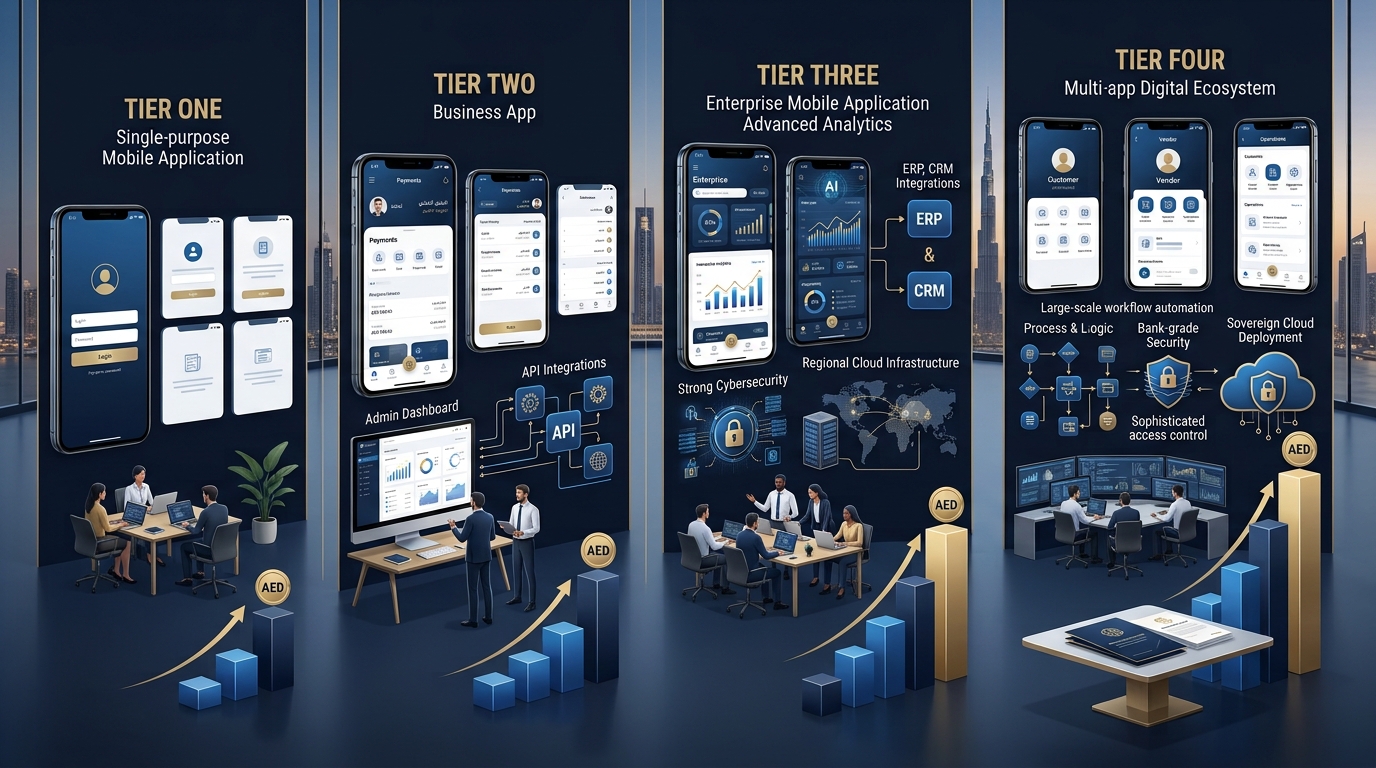
Every app development project falls into one of four distinct financial and structural brackets. Match your commercial objectives to the correct tier before evaluating any proposals.
Tier 1: Basic MVP App — AED 25,000 to AED 80,000
What you get: A highly targeted, single-function product designed to validate one primary user journey. Features are strictly limited: basic email or social media authentication, a standard UI layout, a single payment gateway integration, and basic push notifications.
Who it is for: Early-stage founders validating a proof of concept before raising capital, internal utilities for small operational teams, and startups testing customer acquisition hypotheses before committing to a full build.
Timeline: 6 to 12 weeks.
Platform: Almost exclusively cross-platform frameworks such as Flutter or React Native, producing both iOS and Android from a single codebase to conserve capital.
Warning: Quotes below AED 40,000 for a custom build almost always rely on rigid pre-built templates or produce non-functional mockups rather than scalable, maintainable products. A template-based app will typically require a complete rebuild within six to twelve months as your operational requirements grow.
Tier 2: Mid-Level Business App — AED 80,000 to AED 300,000
What you get: A professional production application with multiple user permission levels, localized UAE payment gateway integrations such as PayTabs, Telr, or Network International, native bilingual Arabic and English support with full right-to-left UI, an admin dashboard, robust third-party API configurations, and a secure backend capable of handling traffic spikes.
Who it is for: Mid-sized UAE enterprises, growing regional brands, and venture-backed startups building automated transactional models. According to Decipher Zone’s 2026 UAE pricing analysis, the mid-level business application sits most commonly between AED 92,000 and AED 294,000 in the Dubai market, and represents the bracket with the most volatile variance in agency bidding.
Timeline: 3 to 6 months.
Platform: Advanced cross-platform deployment or native codebases, depending on specific performance requirements.
Tier 3: Complex or Enterprise App — AED 300,000 to AED 800,000+
What you get: A multi-layered enterprise application using custom machine learning models or predictive AI, deep integrations with ERP and CRM systems such as SAP, Oracle, or Salesforce, complex data routing architecture, full UAE data sovereignty compliance, and comprehensive QA and dedicated delivery management.
Who it is for: Financial institutions, logistics networks, healthcare providers, and high-transaction consumer marketplaces requiring near-absolute uptime and regulatory compliance.
Timeline: 6 to 12 months.
Platform: Native iOS using Swift and Android using Kotlin developed concurrently, or hybrid cross-platform layouts with low-level native modules for peak performance.
Tier 4: Enterprise Platform — AED 800,000 and Above
What you get: A comprehensive interconnected digital ecosystem, including separate apps for customers, vendors, and operations teams, supported by sophisticated workflow automation, bank-grade security protocols, and deployment on sovereign cloud infrastructure.
Who it is for: Government institutions, multinational conglomerates, and dominant digital platforms where the software is the primary operational infrastructure of the entire enterprise.
Timeline: 12 months or more of continuous engineering. These agreements are structured as managed team retainers rather than fixed-price single deliveries.
At-a-Glance Pricing Summary
| App tier | AED range | USD equivalent | Timeline | Platform |
|---|---|---|---|---|
| Basic MVP | AED 25,000 to 80,000 | USD 6,800 to 21,800 | 6 to 12 weeks | Cross-platform |
| Mid-level business | AED 80,000 to 300,000 | USD 21,800 to 81,700 | 3 to 6 months | Cross-platform or native |
| Complex or enterprise | AED 300,000 to 800,000+ | USD 81,700 to 217,800+ | 6 to 12 months | Native or hybrid |
| Enterprise platform | AED 800,000+ | USD 217,800+ | 12+ months | Native, multi-app |
AED/USD conversion at AED 1 = USD 0.272 (May 2026)
The 6 Factors That Explain Every Quote You Receive
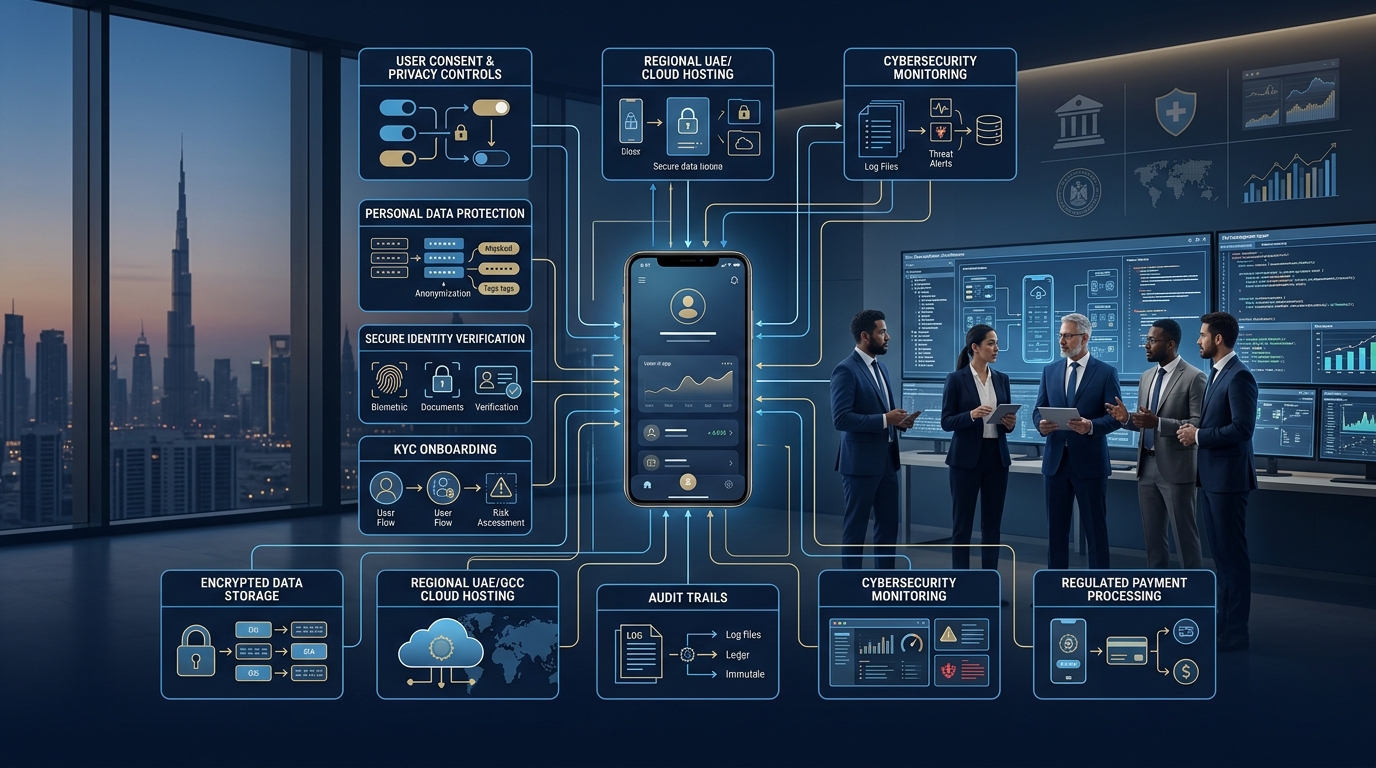
When a developer reviews your app requirements, they are not seeing features. They are estimating engineering hours. Labour represents 60 to 70 percent of the total mobile app development cost, according to Innovatrix Infotech’s 2026 AED pricing guide. Understanding how those hours accumulate across six key variables lets you evaluate any proposal with clarity.
1. Platform Choice: Native vs Cross-Platform
Building separate native applications for iOS and Android requires two distinct engineering tracks in different programming languages, effectively doubling your interface development hours. Cross-platform frameworks such as Flutter and React Native allow a single engineering team to deploy to both platforms simultaneously from one codebase.
According to Riseup Labs’ 2026 analysis, over 60 percent of new Dubai apps are built cross-platform, and adopting a cross-platform strategy can reduce initial development costs by 20 to 40 percent, according to GoodFirms’ 2026 Dubai analysis. Native architecture remains necessary only for products requiring hardware-intensive processing such as low-level Bluetooth scanning, complex augmented reality, or custom real-time video engines.
2. Feature Complexity
Every complex feature adds engineering hours in multiples, not increments. The most resource-intensive elements in the UAE market include real-time geospatial mapping with dynamic routing, multi-party live chat with offline persistence, AI-driven recommendation or personalization models, and multi-tier admin dashboards handling secure corporate actions. Each of these introduces multiple layers of integration, asynchronous state management, and edge-case debugging that can add weeks to your timeline and thousands to your final AED estimate.
3. UAE Regulatory Compliance
Deploying software in the UAE requires compliance with the UAE Personal Data Protection Law, Federal Decree-Law No. 45 of 2021, which applies to any application collecting, storing, or transferring personal data of UAE residents. Fintech applications require Central Bank-compliant KYC onboarding. Healthcare apps must meet DHA or HAAD data standards. Building in regulated sectors can increase engineering costs by 30 to 50 percent compared to unregulated consumer apps, because compliance must be engineered into the architecture from day one, not added later.
Warning: Compliance requirements cannot be deferred to a later version. A payment application that launches without PDPL-compliant data schemas or a fintech product without Central Bank KYC flows will be rejected by regulators before it reaches users. The cost of retrofitting compliance after launch is consistently higher than building it correctly from the start.
4. Arabic Language and RTL Support
A single-language English product in the UAE is, functionally, half a product. True Arabic localization requires comprehensive right-to-left mirror-imaging of every UI component, precise Arabic typographical styling, and localized content management. This means adapting user workflows, button states, form fields, and navigation flows to display correctly in RTL, not running text through a translation service.
| Interface element | English LTR | Arabic RTL |
|---|---|---|
| Navigation bar | Logo left, menu right | Menu left, logo right |
| Form fields | Left-aligned labels | Right-aligned labels |
| Buttons | Right-positioned primary action | Left-positioned primary action |
| Text alignment | Left | Right |
| Icon placement | Left of label | Right of label |
Building Arabic RTL into the architecture from day one is far more efficient than attempting to retrofit an English-centric codebase with RTL support after launch. The rework cost of retrofitting is typically 25 to 40 percent of the original build cost.
5. Backend Complexity and Integrations
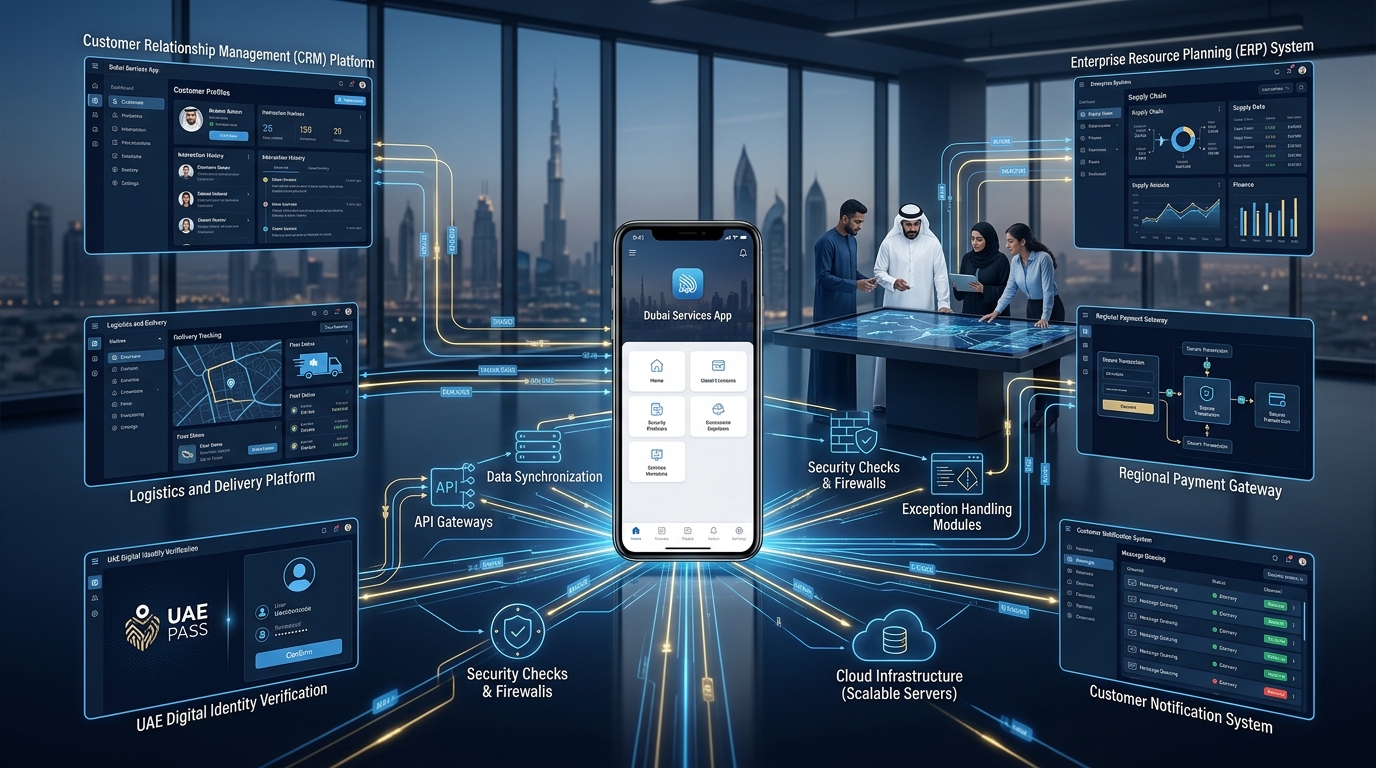
An application serving a local database is relatively inexpensive to build. Costs escalate when your app must communicate with existing enterprise systems including legacy ERPs, CRM platforms, third-party logistics APIs, or government networks. Every integration point requires custom API handshakes, exception-handling protocols, and continuous synchronization tests.
Freit Technologies’ enterprise solutions practice specializes in these cross-system integrations for UAE enterprises, connecting ERP systems such as SAP, Odoo, ERPNext, and Microsoft Dynamics 365 with custom-built applications. Utilizing UAE-specific systems such as UAE Pass for national digital identity verification or regional payment processors including PayTabs, Telr, and Network International requires specific regional expertise that directly influences both timeline and cost.
6. Who Builds It and Where
The structure and location of your development team produces the most dramatic variance in any quote you receive. Developer hourly rates in the Dubai market vary significantly by seniority and vendor type.
| Developer tier or vendor type | Hourly rate (AED) |
|---|---|
| Junior software engineer | AED 100 to 180 per hour |
| Senior software engineer | AED 300 to 600 per hour |
| Specialist AI or blockchain engineer | AED 500 to 900 per hour |
| Full-service Dubai agency | AED 200 to 550 per hour |
| Offshore or remote engineering team | AED 70 to 150 per hour |
To balance cost and quality, many UAE businesses use hybrid development models: local Dubai-based project management and solution architecture paired with offshore engineering execution. This hybrid approach can reduce development costs by 30 to 60 percent while maintaining local compliance oversight and communication quality.
Ready to scope your app with a team that understands the UAE market? Freit Technologies scopes before it quotes, ensuring you receive a precise number based on what you actually need to build. Talk to our team today.
What Your Quote Does Not Include But Your Budget Must
The real cost of a mobile application extends well beyond the initial development invoice. Many agencies submit low initial bids by stripping out long-term operational requirements, leaving clients to discover the gaps after go-live. Hidden post-launch costs consistently consume 45 to 70 percent of the initial development budget when maintenance, marketing, and hosting are factored across year one. Every item below must appear in your multi-year budget.
Annual Maintenance and Platform Adaptation: 15 to 25 Percent of Original Build Cost
Software is living infrastructure. Every iOS or Android update, every third-party API authentication change, and every security patch your product depends on requires maintenance work. Annual app maintenance costs consistently average 15 to 25 percent of the original development investment, according to GoodFirms’ 2026 research. Launching without an allocated maintenance budget results in rapid technical obsolescence within twelve to eighteen months.
App Store Fees and Transaction Commissions
Maintaining active developer accounts requires annual fees: approximately AED 365 (USD 99) per year for the Apple Developer Program and a one-time fee of approximately AED 92 (USD 25) for Google Play. Both ecosystems apply a 30 percent commission on in-app digital purchases and subscriptions, reducing to 15 percent for long-term recurring subscriptions. If your revenue model includes any in-app digital monetization, treat this commission as a permanent cost of goods sold, not a technical overhead item.
Cloud Infrastructure and Data Sovereignty Costs
A mid-tier application supporting roughly 50,000 monthly active users typically requires between USD 500 and USD 3,000 per month in cloud infrastructure, according to GoodFirms’ 2026 analysis. UAE PDPL compliance often requires hosting on UAE or GCC regional cloud nodes such as AWS Bahrain or Azure UAE North, which carry minor regional pricing premiums versus global server regions. These costs are ongoing and scale with user growth.
Quality Assurance and Security Testing: 15 to 20 Percent Addition
Standard competitive quotes reduce QA hours to lower the headline price. A comprehensive testing program covering cross-device usability, performance stress testing, and security vulnerability scanning adds 15 to 20 percent to the total timeline and budget. According to GoodFirms’ 2026 research, you should add 25 to 35 percent to your initial development budget to account for post-launch costs. Skipping QA does not save money. It defers costs to post-launch bug fixes, which are consistently more expensive than preventive testing.
Post-Launch Feature Iteration Sprints
No application survives its first encounter with real users completely unchanged. User feedback will highlight UX friction points and feature gaps that require adjustment. Plan for two to three post-launch development sprints during the first six months and allocate a specific budget for them before the build begins. Treating the launch invoice as the complete cost of your product is one of the most common and most expensive planning mistakes UAE founders make.
Pre-Launch Budget Checklist for Dubai App Projects
Use this checklist before committing any capital to a mobile app development project:
- [ ] Development build cost aligned to the correct tier based on confirmed feature requirements
- [ ] Annual maintenance budget allocated at 15 to 25 percent of the build cost
- [ ] Cloud hosting budget confirmed for 12 months post-launch, using UAE regional servers for PDPL compliance
- [ ] Apple Developer Program fee (AED 365 per year) and Google Play one-time fee (AED 92) accounted for
- [ ] App Store commission (30 percent of in-app purchases) factored into revenue model
- [ ] Arabic RTL support confirmed as in-scope in the development contract
- [ ] PDPL compliance architecture confirmed as included, not a future phase
- [ ] UAE-approved payment gateway (PayTabs, Telr, or Network International) specified and scoped
- [ ] QA and security testing confirmed as a line item in the proposal
- [ ] Post-launch sprint budget reserved for months 1 through 6
Local Agency vs Offshore vs Hybrid: What Each Actually Costs
Choosing a development partner affects your budget and risk profile more than almost any feature decision.
| Model | Cost range | Risk level | Best suited for |
|---|---|---|---|
| Local Dubai agency | AED 200 to 550+ per hour | Lowest | Enterprise, government, heavily regulated verticals |
| Offshore freelancer or agency | AED 70 to 150 per hour | Highest | Non-regulated MVPs, standard global utilities without UAE-specific requirements |
| Hybrid model | 30 to 60 percent savings vs local | Controlled | Market-ready MVPs, fast-growing startups, regional SMEs |
Local Dubai agency: Provides end-to-end local accountability, physical proximity for strategy sessions, and native understanding of UAE regulatory frameworks, Arabic UX patterns, and payment gateway integrations. Premium rates reflect structured workflows, specialized talent, and comprehensive QA. Best suited for enterprise operations, government contracts, and regulated verticals where local liability matters.
Offshore freelancer or agency: Offers significant initial savings but introduces communication overhead, time-zone friction, and limited familiarity with UAE-specific requirements including Arabic RTL implementation, UAE Pass integration, and PDPL compliance. Suitable only for technically straightforward applications without localized compliance requirements, and only when an experienced internal technical lead can manage daily production.
Hybrid model: Local Dubai-based project managers, product strategists, and solution architects paired with specialized offshore engineering teams. This model retains local accountability, real-time communication, and compliance oversight while benefiting from cost-effective development execution. According to the Innovatrix Infotech 2026 AED pricing guide, the hybrid model delivers an enterprise-grade Dubai MVP in the AED 80,000 to AED 140,000 range on a Flutter dual-platform build within a 10 to 14 week delivery window.
Five Questions to Ask Before Signing Any Contract
Ask every prospective development partner these five questions before committing capital or signing a deposit agreement. Any partner unable to answer them clearly in writing is under-scoping the project or concealing costs that will surface after you have committed.
Question 1: “Does this quote explicitly include native Arabic RTL layout optimization, or is localization classified as out-of-scope?”
Question 2: “Is the system architecture engineered for full UAE PDPL compliance from day one, and where exactly will user data be hosted?”
Question 3: “What specific QA mechanisms are included in this timeline, and how many iterative feedback cycles are covered before launch?”
Question 4: “What are the ongoing costs for platform maintenance and cloud hosting post-launch, and are those managed through a separate SLA?”
Question 5: “Can you provide a clear breakdown of who writes the code — local onsite developers, an offshore team, or a hybrid model?”
A thorough, line-item proposal that addresses all five points is a strong signal of an honest development partner. A low-ball estimate that ignores them is a strong signal of hidden costs ahead.
Frequently Asked Questions
Q1: What is the cheapest way to build a mobile app in Dubai?
The most cost-effective path to a production-ready mobile application in Dubai is a cross-platform MVP built via a hybrid execution model combining local project management with offshore development. Keeping your scope strictly limited to a single, essential user journey typically requires a budget between AED 50,000 and AED 80,000. Be cautious of quotes below AED 40,000 for any custom build. These almost always use rigid pre-built templates or produce non-functional mockups rather than scalable, maintainable products. The mobile app development cost in Dubai reflects genuine market standards, and extreme outliers on the low end carry proportionate risks.
Q2: How long does it take to build a mobile app in Dubai?
A standard mid-level business application typically requires 3 to 6 months from initial scoping to app store deployment. Complex or heavily regulated enterprise products take between 6 and 12 months. The most common causes of delays are mid-development scope changes, slow approval cycles on UI designs, and unexpected integration challenges with external APIs or UAE-specific systems. Development partners offering aggressive timelines without a formal discovery phase are almost always operating on assumptions that break down during build. A realistic scoping session before any code is written is the most effective way to protect your delivery timeline.
Q3: Should I build a native app or a cross-platform app for the Dubai market?
For the majority of UAE commercial deployments in 2026, cross-platform development using Flutter or React Native is the practical and cost-effective choice. Modern cross-platform frameworks offer performance that matches native apps for most business use cases while reducing development costs by 20 to 40 percent through a single shared codebase. Native development should be reserved for products that require deep hardware integration such as advanced on-device camera processing, complex augmented reality, or intensive real-time Bluetooth data routing. Most UAE business applications do not require native-only capabilities, and choosing native without a specific technical justification is one of the clearest drivers of unnecessary mobile app development cost in Dubai.
Q4: Does building a mobile app in Dubai require Arabic language support?
While not a blanket legal requirement for all application categories, providing native Arabic support is an operational necessity for any UAE consumer-facing product. The UAE has 99 percent internet penetration and 95 percent smartphone adoption, and a significant portion of the user base expects an intuitive Arabic interface. Proper Arabic support requires full right-to-left interface mirroring and localized workflows, not just text translation. Building RTL support into the architecture from the start is significantly more efficient than retrofitting it onto an English-centric codebase. For B2B applications or enterprise tools serving primarily English-speaking professional teams, an English-first launch with Arabic as a planned second version is an acceptable sequencing strategy.
Q5: What should my total first-year app budget include beyond the build cost?
Your total first-year financial plan must cover annual technical maintenance at 15 to 25 percent of your initial build cost, cloud infrastructure hosting between AED 1,800 and AED 11,000 or more per year depending on user traffic, Apple Developer Program fees at AED 365 per year, the Google Play one-time registration fee at AED 92, post-launch feature iteration sprints, and any compliance audits required for your sector. A realistic total cost of ownership for year one typically runs 140 to 160 percent of your initial development invoice. Planning for this range before committing to a build budget protects your operational runway and prevents the budget shortfalls that stall many otherwise sound Dubai app projects.
Q6: How does UAE PDPL compliance affect mobile app development cost in Dubai?
UAE PDPL compliance adds meaningful cost to any mobile application that collects, stores, or processes personal data of UAE residents, which covers almost every consumer or business application. Compliance engineering includes implementing explicit consent mechanisms at every data collection point, building user rights workflows for access, rectification, and erasure, configuring cloud infrastructure to meet UAE data residency requirements, and producing documentation sufficient for a regulatory audit. In regulated sectors, compliance can add 30 to 50 percent to engineering costs compared to unregulated consumer apps. The cost of retrofitting compliance after go-live is consistently higher than building it correctly from the beginning.
Q7: What payment gateways should a Dubai mobile app integrate, and does it affect cost?
The most commonly integrated UAE-approved payment gateways for mobile applications in 2026 are PayTabs, Telr, Network International, and Stripe. Each gateway has distinct merchant onboarding timelines, AED settlement structures, and technical integration requirements. UAE-specific gateways generally require more implementation work than global processors such as Stripe due to regional API specifications and onboarding documentation requirements. Budget an additional AED 5,000 to AED 20,000 for each major payment gateway integration depending on complexity. If your revenue model depends on in-app digital purchases, factor the 30 percent App Store or Google Play commission into your unit economics before finalizing the build specification.
Q8: What is the mobile app development cost in Dubai for an AI-powered application?
AI features in mobile applications fall into two categories with very different cost implications. Applications using existing AI APIs such as OpenAI, Claude, or Gemini for natural language processing, content generation, or chatbot capabilities can integrate these features at relatively modest additional cost, typically adding AED 15,000 to AED 50,000 to a standard build depending on complexity. Applications requiring custom AI model training, predictive analytics on proprietary datasets, or real-time machine learning inference require specialist AI engineering, significantly more data preparation work, and ongoing model maintenance. Custom AI implementations for UAE applications typically begin at the Tier 3 price range (AED 300,000 and above) and require a dedicated data readiness assessment before scoping. Freit Technologies’ AI automation services cover both API-based and custom AI integrations for UAE businesses across all sectors.
Clarity Determines Outcome More Than Capital
Two Dubai-based founders once launched competing software products. The first operated with a tightly defined MVP scope and a budget of AED 110,000. The second secured AED 735,000 in seed capital and insisted on building a comprehensive feature set all at once. The first launched within four months, secured paying users, and used real revenue to fund the next sprint. The second spent twelve months managing scope creep, ran out of capital before completing backend integrations, and missed the market window entirely.
The mobile app development cost in Dubai does not determine whether your product succeeds. The clarity of your scope before the first line of code is written is what determines the outcome.
Freit Technologies scopes before it quotes. We build web and mobile applications for UAE startups and enterprises with full PDPL compliance, Arabic RTL support, and UAE payment gateway integration built in from day one. Want a real cost estimate for your app — not a range, but a scoped number based on what you actually need to build? Talk to our team today.
Disclaimer: All pricing figures in this guide represent indicative market ranges for 2026 based on publicly available data from multiple UAE market sources. Final project costs depend on confirmed scope, feature complexity, integration requirements, team structure, and regulatory obligations specific to your application. AED/USD conversions use AED 1 = USD 0.272 (May 2026). Freit Technologies provides scoped estimates based on individual project requirements, not generic range quotations.